You are now leaving the Lilly Medical Education website
The link you clicked on will take you to a site maintained by a third party, which is solely responsible for its content. Lilly USA, LLC does not control, influence, or endorse this site, and the opinions, claims, or comments expressed on this site should not be attributed to Lilly USA, LLC. Lilly USA, LLC is not responsible for the privacy policy of any third-party websites. We encourage you to read the privacy policy of every website you visit.
Click "Continue" to proceed or "Return" to return to Lilly Medical Education.
HR+, HER2- Metastatic Breast Cancer
ET Advancements
Scientific advancements in endocrine therapy (ET) seek to maximize antagonizing the estrogen receptor (ER) pathway in ER-positive (ER+), human epidermal growth factor receptor 2–negative (HER2-) advanced breast cancer.1-3
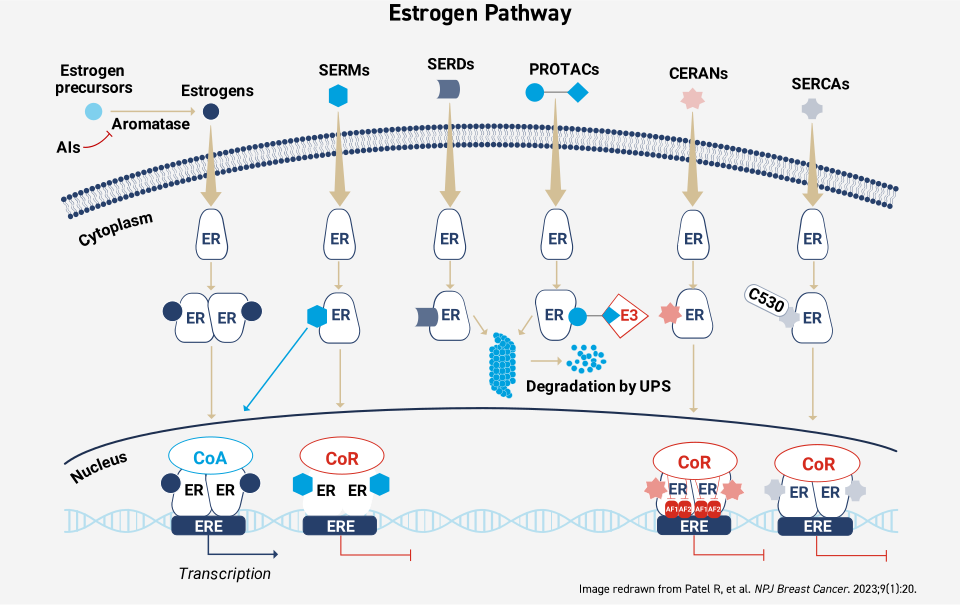
AIs block estrogen production by inhibiting aromatase. SERMs block ER transcription by competitively inhibiting the binding of estrogen to ER. SERDs block ER translocation to the nucleus, and upon binding to ER, results in degradation of the SERD-ER complex. PROTACs bind to both ER and the E3 ubiquitin ligase, resulting in ubiquitination and degradation. CERANs block both transcriptional activation domains of ER. SERCAs inhibit ER gene transcription by binding to the C530 cysteine residue on ER.3

- Sustained high, dose-dependent exposure supporting oral options1-3

- Potent and highly specific binding to both wildtype and mutated ER1,3
- Maintain activity in aromatase inhibitor (AI)-resistant and ESR1-mutant models1-3

- Selective estrogen receptor degraders (SERDs) and proteolysis targeting chimeras (PROTACs) have potent ER degradation and suppression of ER-dependent signaling1-3

As healthcare providers, it is important to stay updated on next-generation oral ETs and how they may be used as monotherapy or in combination with targeted therapies. For more information on advancements in novel ETs and ongoing clinical trials, please see additional resources below.
Related Resources
Downloadable PDFs
This infographic provides an overview of the approved and investigational ET classes in ER+, HER2-, ABC; highlights the potential benefits of next-generation ETs, resulting in more potent endocrine pathway antagonism.
This slide deck provides an overview of the ER+, HER2- advanced breast cancer landscape, including information on ER targeted therapies, mechanisms of resistance to ET +/- CDK4/6 inhibitors, & scientific advancements in the form of next-generation ETs.
(00:00) Light music and animation
(00:16) Lower thirds title animates on as speaker responds to title card prompt. Music fades.
Endocrine therapies (ETs) either block the estrogen receptor (ER) or deprive the tumor of endogenous estrogen. And this class of drugs can be really used in various lines of treatment, as long as the tumors are endocrine sensitive. Selective ER down regulators or degraders (SERDs) are a type of ET that bind to the ER to suppress its transcriptional activity and trigger its degradation. The very first SERD, fulvestrant, was developed nearly 20 years ago and was described as a pure ER antagonist. It demonstrated efficacy in patients exposed previously to aromatase inhibitors (AIs). It is widely used as monotherapy and in combination with targeted agents in pre- and postmenopausal patients with hormone receptor–positive (HR+), HER2–negative (HER2-) metastatic breast cancer (MBC).
(01:07) Full-screen graphic. Question moves to Lower Third position. Reveals speaker. Question fades away.
Fulvestrant, while providing benefit to our patients, certainly has its limitations, including toxicity and pharmacologic limitations. For instance, the poor solubility of fulvestrant requires intramuscular (IM) administration by a healthcare professional at a medical office. Over the years, we've learned that fulvestrant's efficacy is dose dependent. The currently approved dose of 500 mg IM injection was superior than 250 mg, but we’re not able to go any higher. Fulvestrant is also historically used after progression on an AI monotherapy in the metastatic setting. Now that [a] majority of our patients, if not all, are receiving AI with CDK4/6 inhibitors (CDK4/6i) in the first-line (1L) metastatic setting, we have now begun to notice that fulvestrant offers a very modest efficacy in patients who are exposed to CDK4/6i, and this is in the order of a median progression-free survival (PFS) of only 2 to 3 months. Forty to 50 percent of our patients develop ESR1 mutations [due] to prior AI therapy, and fulvestrant is not very effective for certain ESR1 mutations including Y537S.
(02:26) Full-screen graphic. Question moves to Lower Third position. Reveals speaker. Question fades away.
We're starting to see a rise in the research of novel endocrine agents, with oral SERDs being the furthest in clinical development. And as of 2023, we already have regulatory approval for the very first oral SERD, which is indicated for postmenopausal women and adult men with HR+, HER2-, ESR1-mutant MBC, following progression on 1L standard-of-care (SOC) therapy. Clinical data from the first approved oral SERD suggests an improved PFS compared to SOC ET. An increased benefit was seen in patients with ESR1 mutations, suggesting that ESR1 mutations are a surrogate for endocrine sensitivity and continuing to target this pathway remains relevant despite progression on prior ET.
SERDs: Relevance and Role in Current & Future Treatments for HR+, HER2- MBC
In this video, Dr. Komal Jhaveri shares her expertise on SERDs for the treatment of HR+, HER2- MBC, including the evolving role of novel oral SERDs.
References
- Llyod MR, et al. Ther Adv Med Oncol. 2022;14:17588359221113694.
- Mittal A, et al. Cancers (Basel). 2023;15(7):2015.
- Patel R, et al. NPJ Breast Cancer. 2023;9(20). doi: 10.1038/s41523-023-00523-4
VV-MED-157398
Please rate your satisfaction with the content on the following statements:
Very Dissatisfied
Dissatisfied
Neutral
Satisfied
Very Satisfied